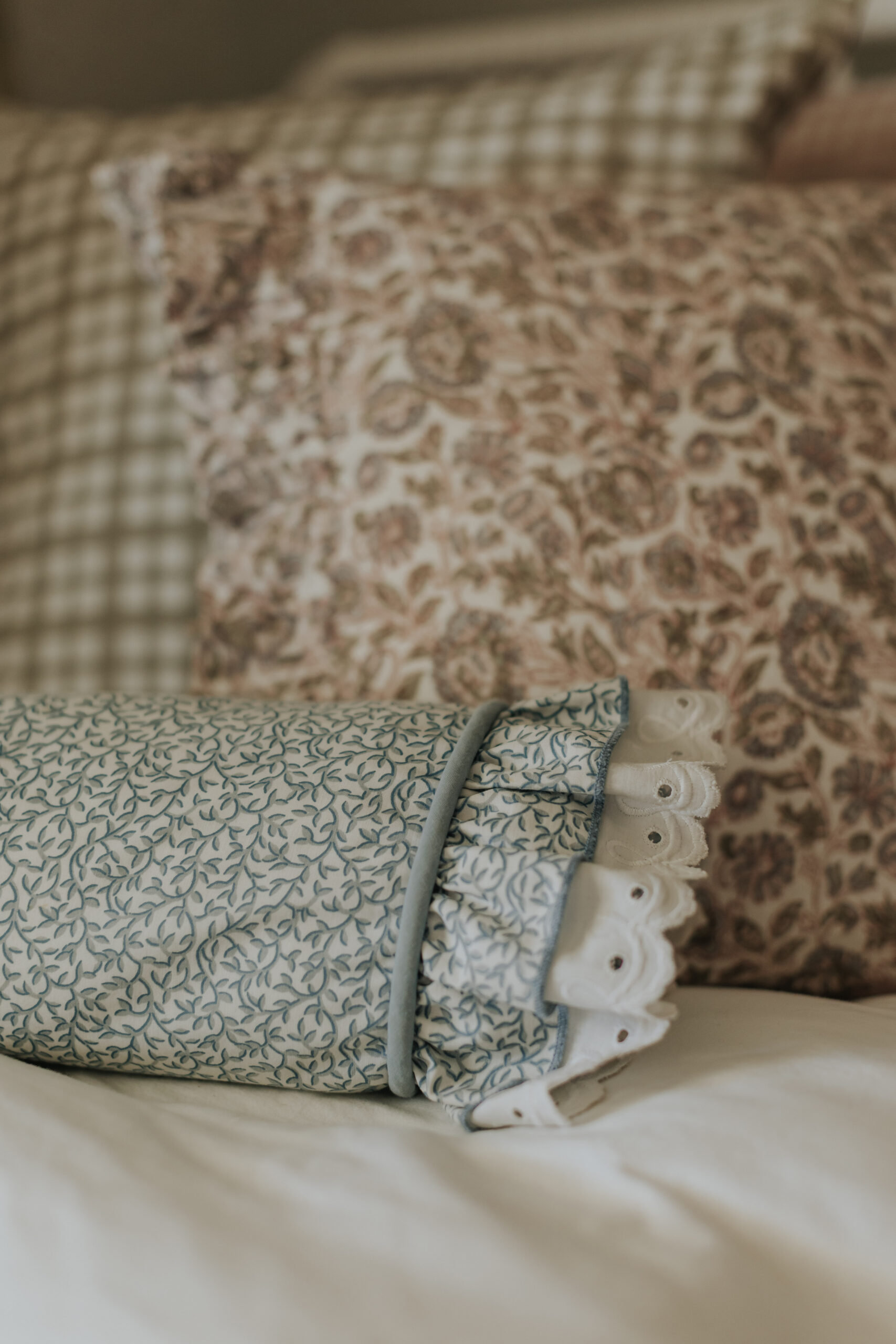
There’s a hesitation that comes over most people when they think about mixing patterns. It feels risky, like something that could easily go wrong. Too many patterns and the room feels chaotic. Too few and it feels flat. Get the scale wrong and everything competes. Choose the wrong combinations and nothing quite works together.
But here’s the truth: mixing patterns doesn’t have to be complicated or stressful. In fact, when done with a few simple principles in mind, it’s one of the most effective ways to create depth, warmth, and that collected, timeless feeling we’re all after in a cottage home.
Pattern brings life to a room. It adds visual interest, creates movement, and makes spaces feel layered and intentional. The key is approaching it with restraint and a clear understanding of what works—not following trendy formulas, but learning the timeless principles that allow patterns to coexist beautifully.
Let me walk you through how to mix patterns in a way that feels simple, grounded, and effortlessly elegant.
Start with a Unifying Color Palette
Before you think about which patterns to choose, establish your color palette.
This is the foundation that allows different patterns to work together harmoniously. When patterns share a common color thread—even if they’re wildly different in style—they’ll feel cohesive rather than random.
Your palette doesn’t need to be complicated. In fact, simpler is almost always better. Choose 2-3 main colors plus neutrals. For example: soft blues and warm taupes with cream and white. Or muted greens and rust with natural linen tones.
Once you have your palette, every pattern you introduce should pull from those same colors. A blue and white gingham pillow, a cream rug with blue undertones in the pattern, a floral print that incorporates both blue and taupe—these will all work together because they’re speaking the same color language.
A unifying color palette is the foundation that allows different patterns to feel cohesive rather than chaotic.
Understand Pattern Scale: Small, Medium, Large
One of the most important principles in mixing patterns is varying the scale.
Small-scale patterns are intricate and detailed—tiny florals, delicate stripes, small checks, fine geometrics. These read almost like texture from a distance and create visual interest without overwhelming.
Medium-scale patterns are your workhorses—classic gingham, medium florals, standard stripes, traditional Persian rug designs. They’re substantial enough to be seen and appreciated but not so large that they dominate.
Large-scale patterns make a statement—oversized florals, wide stripes, bold geometrics, dramatic damasks. These are your anchors, the patterns that draw the eye first.
When you mix patterns, vary the scale. A large-scale floral pillow pairs beautifully with a medium-scale striped throw and a small-scale check on a chair. The different scales create visual hierarchy and prevent patterns from competing with each other.
If everything is the same scale, the patterns fight for attention. When scales vary, they work together to create depth.
Varying pattern scales creates visual hierarchy—large patterns anchor, medium patterns support, small patterns add detail.
The Power of Stripes, Checks, and Florals
There are certain pattern types that are inherently timeless and mix beautifully together.
Stripes are classic, versatile, and work with nearly everything. They can be soft and subtle or bold and graphic. Ticking stripes, pinstripes, wide awning stripes—all bring linear rhythm that balances more organic patterns.
Checks and plaids bring a cottage, farmhouse warmth. Gingham, buffalo check, windowpane—these patterns feel grounded and approachable. They’re particularly wonderful for mixing because they’re geometric but not cold.
Florals add softness and romance. Whether delicate and vintage-inspired or bolder and more stylized, florals bring an organic quality that balances the structure of stripes and checks.
These three pattern families work beautifully together because they offer contrast: linear versus organic, structured versus soft, geometric versus flowing. A striped rug, a checked pillow, and a floral throw? That’s a classic, timeless combination that never feels forced.
Stripes, checks, and florals are the foundational pattern types that mix effortlessly and timelessly.
Keep Your Neutrals Quiet
In a room with mixed patterns, your solid, neutral pieces become just as important as the patterned ones.
Neutrals give the eye a place to rest. They create breathing room between patterns and prevent the space from feeling too busy. Without enough neutrals, even the most beautiful pattern combination can feel overwhelming.
This is where your solid linen pillows, your cream throws, your plain painted walls, your natural wood furniture all come into play. They’re the quiet backdrop that allows your patterns to shine without competing.
A good rule of thumb: for every patterned element, have at least one solid element nearby. A patterned pillow next to a solid one. A patterned rug with a solid sofa above it. A patterned wallpaper with solid curtains.
The solids don’t need to be boring—they can have texture, interesting weaves, subtle tonal variations. But they should be quiet enough to let the patterns do their work.
Neutrals give patterns room to breathe—without them, even beautiful combinations feel chaotic.
Start Small and Build Gradually
You don’t need to mix patterns everywhere all at once.
In fact, the most successful pattern mixing happens gradually, as you layer pieces into a room over time. Start with one patterned anchor—maybe a beautiful rug with a traditional design. Live with it for a while. Then add a patterned pillow that pulls a color from the rug. See how it feels.
Eventually, you might add patterned wallpaper or a floral throw or checked curtains. But each addition should feel intentional, not forced. If something doesn’t feel right, it probably isn’t. Trust your eye.
Starting small also means you can test combinations without commitment. Pillows are easy to swap. Throws can be moved from room to room. A small patterned runner on a console table is a low-risk way to introduce pattern before committing to a patterned sofa.
Pattern mixing is a process, not a one-time decision—build gradually and trust what feels right.
The Rule of Three (But Don’t Be Rigid)
A helpful guideline is the rule of three: use three different patterns in a space, varying the scale.
For example, in a living room: a large-scale patterned rug, a medium-scale striped pillow, and a small-scale floral accent. The variety creates interest, but limiting it to three keeps things from feeling chaotic.
That said, this isn’t a hard rule. Some rooms work beautifully with just two patterns. Others can handle four or five if they’re layered thoughtfully and balanced with enough solids.
The point isn’t to count patterns obsessively—it’s to be mindful that more isn’t always better. Three well-chosen patterns will always feel more cohesive than six competing ones.
Three patterns with varied scales is a helpful starting point—but trust the room, not rigid rules.
Repetition Creates Cohesion
One of the easiest ways to make pattern mixing feel intentional is through repetition.
If you use a blue and white stripe on one pillow, echo that stripe somewhere else—perhaps in a smaller dose on a throw or in the border of a rug. If gingham appears on curtains, let it show up again on a kitchen towel or a small pillow.
This doesn’t mean everything should match. It means creating visual connections that help the eye understand the room is thoughtfully composed rather than randomly decorated.
Repetition of pattern families (multiple florals in different scales, several checks in different sizes) also creates cohesion. When the eye sees related patterns repeated throughout a space, everything feels more collected and intentional.
Repetition of patterns creates visual connections—it’s what makes mixing feel intentional rather than accidental.
Where to Mix Patterns in Each Room
Pattern mixing looks different depending on the room, but the principles remain the same.
In Living Rooms: Layer patterns through pillows, throws, rugs, and possibly wallpaper or curtains. The sofa itself can be patterned or solid—if solid, it becomes your neutral anchor. Mix pillow patterns (large floral, medium stripe, small check) and add a patterned rug that ties the colors together.
In Bedrooms: Bedding is your primary opportunity for pattern. Mix patterned shams with solid or subtly patterned sheets. Add a patterned quilt or coverlet. Layer in patterned pillows with varying scales. A patterned rug beside the bed or patterned wallpaper behind it adds another layer.
In Kitchens: Pattern comes through textiles (gingham or striped towels), tile (patterned backsplash or floor), and even dishware displayed on open shelving. Keep it simple here—the architecture and finishes are already creating visual interest, so patterns should enhance, not overwhelm.
In Dining Rooms: Table linens, chair cushions, curtains, rugs, and wallpaper all offer opportunities for pattern. A patterned rug grounds the table, patterned napkins add charm, and if you’re feeling bold, patterned wallpaper creates a beautiful backdrop for gatherings.
Pattern mixing works in every room—just adjust the scale and quantity based on the space’s purpose and existing visual interest.
When Not to Mix Patterns
Sometimes, a room simply doesn’t need mixed patterns.
If your space already has incredible architectural details, beautiful millwork, or stunning views, adding too much pattern can compete with what’s already there. In these cases, let texture do the work instead. Varied materials, interesting finishes, and layered neutrals can create all the depth you need.
Pattern mixing also isn’t necessary in every single room. If you’ve mixed patterns beautifully in your living room and bedroom, perhaps your bathroom or home office can be quieter and more restrained. Not every space needs to make a statement.
The goal is always a home that feels cohesive and calm, not a home where every room is trying to show off.
Know when to let pattern rest—sometimes texture and beautiful materials are enough.
Common Mistakes to Avoid
Even with the best intentions, pattern mixing can go wrong. Here are the pitfalls to watch for:
Too many large-scale patterns. When everything is big and bold, nothing has room to breathe. Limit large patterns to one or two per room.
Ignoring color palette. Patterns that don’t share any common colors will always feel disjointed, no matter how well-chosen they are individually.
Not enough solids. Patterns need breathing room. If there aren’t enough neutral, solid elements, the space will feel chaotic.
Matching too perfectly. Ironically, when patterns match too closely—same scale, same style, too coordinated—it can feel staged rather than collected. Aim for harmony, not perfect matching.
Forcing it. If a pattern combination doesn’t feel right, trust that instinct. Not every pattern needs to be mixed just because it technically follows the rules.
Avoid these common mistakes by staying grounded in your color palette, varying scales, and trusting your eye.
Examples of Timeless Pattern Combinations
Let me paint a few pictures of pattern mixing that works beautifully:
A living room with:
- A large-scale Persian-inspired rug in muted blues, creams, and taupes
- A medium-scale blue and white striped pillow
- A small-scale floral pillow in cream with hints of blue
- A solid linen sofa in warm taupe
- Solid cream curtains
The rug anchors with its large pattern. The stripes add linear interest. The floral brings softness. The solids create balance.
A bedroom with:
- White sheets (solid)
- A medium-scale ticking stripe duvet in soft gray and white
- Euro shams in a small-scale floral pattern with gray and blush tones
- A lumbar pillow in a larger-scale plaid incorporating the same colors
- A solid linen throw in blush
Each pattern pulls from the same quiet palette. The scales vary. The solids provide breathing room.
A kitchen with:
- Patterned cement tile floor in soft blue-gray and cream (small-scale geometric)
- Gingham tea towels in blue and white (medium check)
- Solid wood cabinetry
- Solid stone countertops
- Solid painted walls
The patterns are limited to textiles and flooring, letting the architecture shine. The gingham echoes the blue from the floor tile, creating cohesion.
Successful pattern mixing shares a color palette, varies scales, and balances patterns with generous solids.
Trust Your Eye and Your Home
At the end of the day, pattern mixing isn’t about following formulas—it’s about creating rooms that feel layered, collected, and authentically yours.
The guidelines I’ve shared are starting points, not rigid rules. Your home, your light, your existing pieces, and your personal style all play a role in what will work best. Sometimes breaking the “rules” creates the most beautiful results.
Pay attention to how a room makes you feel. Does it feel calm and cohesive, or busy and chaotic? Does your eye travel comfortably from pattern to pattern, or does it feel jarred? Do the patterns feel like they belong together, or like they’re fighting for attention?
Your instincts are valuable. Trust them.
The best pattern mixing feels effortless and collected—trust your eye and let your home guide you.
The Beauty of Patterns That Tell a Story
What I love most about mixing patterns is that it allows you to tell your story.
That vintage floral fabric your grandmother loved. The gingham that reminds you of childhood picnics. The striped rug you found on a trip. When patterns are chosen with meaning and mixed with intention, they become more than just decoration—they become layers of your life woven into your home.
This is what makes pattern mixing feel timeless rather than trendy. You’re not following what’s popular—you’re creating something personal, something that will still feel right in ten years because it was never about the moment. It was about building a home that reflects who you are.
Pattern mixing becomes timeless when it’s rooted in meaning, not trends—choose what you love and layer with intention.
Ready to start mixing patterns in your home? Head to my LTK for rugs, pillows, textiles, and all the beautiful patterned pieces that create depth and character in a cottage home.